Music professor talks the unique, yet appropriate nature of the Tuba Christmas tradition
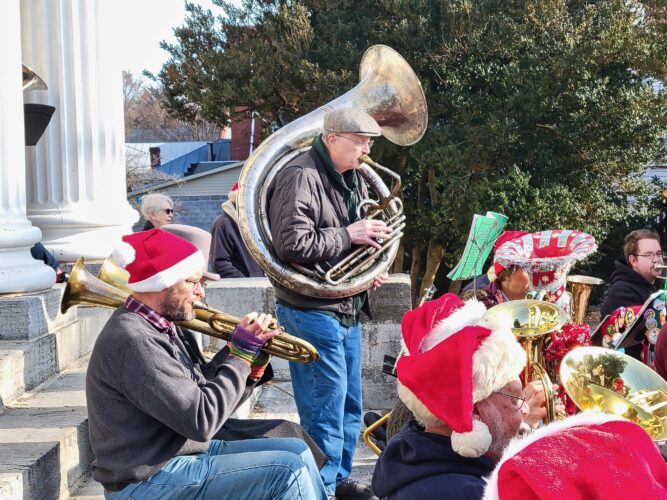
Left to right, over-the-shoulder tenor and baritone horns and a helicon are performed with at the Tuba Christmas concert on Saturday afternoon. Photo by Tabitha Johnston
SHEPHERDSTOWN — The annual Tuba Christmas concert on the steps of McMurran Hall brought holiday cheer and awareness, once again, to the unique attributes of the low registered members of the brass instrument family.
Shepherd University tuba and euphonium professor Simon Wildman, who has been conducting the concert for the last few years, noted there were a number of unique instruments joining this year’s lineup on Saturday afternoon, including a sousaphone, an over-the-shoulder tenor horn, an over-the-shoulder baritone horn, a helicon and a serpent which, unlike the others, was 3D printed rather than an antique.
“People enjoy the novelty of seeing these strange instruments on the stage at the same time,” Wildman said. “That’s why this tradition has been going on for the last 50 years.”
He noted that, with the presence of the over-the-shoulder tenor and baritone horns, the group was looking much like one would have in Shepherdstown’s most noteworthy past.
“These instruments were popularized prior to the Civil War, so this is very close to what a band would have looked like during that time,” Wildman said.
Some of the instruments — like the serpent, which dates back to 1590 — are not well known, as they are no longer in production. Others, however, remain unknown to most Tuba Christmas audiences, due to them having failed to gain as much popularity in the U.S. as they have in other locales.
“The helicon is still used a lot in Europe, for bands when they go marching down the street,” Wildman said, noting the helicon being played at the concert was produced in 1912. “Here in the U.S., we tend to use the sousaphone for the same purpose. They’re mostly the same thing, but the helicon has more of a front curve to it.”
Celebrating the diverse assortment of low-registered instruments — of which there were 25 in all — could be done at any time of the year. Choosing to do so at Christmastime seemed particularly appropriate, however, based on Wildman’s years of observation.
“One thing I have increasingly noticed as I’ve grown older, is how often the shape of these instruments is used in Christmas decorations of all kinds. You see a lot of tuba. You see a lot of French horn. They have very beautiful, but unique shapes that you don’t see represented very much elsewhere,” Wildman said. “It fits with the beauty and the novelty of Christmas — such a special time, which we only experience once a year.”
Local News
Family’s museum exhibit installation legacy continues on, with establishment of new business

In a ‘Holi-Daze’: Parents get a break from the chaos at new library event