Stone Row: 18th century brewery to 21st century homes
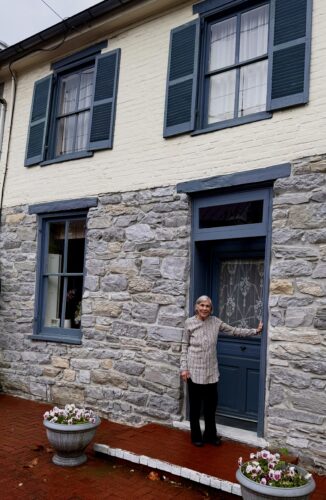
Suzie Patrick stands in front of her home on Stone Row. Courtesy photo
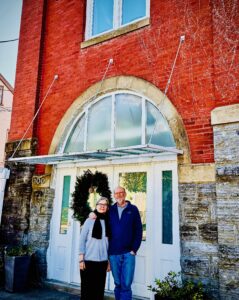
Driving or walking down New Street from Duke to Princess is a Shepherdstown highlight, with the town’s architectural and historic diversity on display: historic homes, newer homes of interest, glimpses of well-tended gardens, the Shepherd Burial Ground and an above ground view of Town Run. Just beyond the repurposed 1912 Gothic style Fire Hall may be among the most surprising architectural features on the street and in town — four connected rowhouses known locally as Stone Row.
Suzie Patrick moved to 104 East New Street in 2011, one of the four houses that make up Stone Row. For many years, she and her husband visited childhood friends who had a weekend home in Shepherdstown, including annually, to attend the Contemporary American Theater Festival. They lived in a neighborhood south of Old Town Alexandria near the Potomac River for 30 years. For much of that time, they operated a crafts shop at Ronald Reagan Washington National Airport, including carrying Smithsonian Institution products.
They moved to Philadelphia to a retirement community, but Patrick’s husband passed away soon after.
“I had no intention of remaining in a retirement community and began thinking about a town where I could become active and involved. Returning to Shepherdstown for the theater festival, I thought I could live here. When I saw the house on Stone Row, that was it,” Patrick said.
Her story is not unlike many who move here seeking community and involvement.
The history of her home originates around 1792, when Philip Shutt built a limestone brew house, drawing from Town Run’s spring fed waters to produce Shutt’s Cream Beer, popular among local residents and later with Irish laborers working on the Chesapeake and Ohio Canal. In the 1830s, the brew house went into decline. Shutt’s daughter and son-in-law later added a brick second story and partitioned the building into separate dwelling units. Years later, the structure became known locally as Stone Row, though a deed from 1866 suggests that it had also been known as Fawcett’s Row after a purchase of the building in 1848 by William Fawcett. During the late 1800s, stone buildings in the back were tied into the main structure, resulting in large rooms with handsome interior stone walls. Upton S. Martin Sr., who built the Shepherdstown Opera House in 1910 and served as mayor, bought a Stone Row home in 1935. During much of the 20th century, the stone exterior was covered with paint or stucco, with the final section of stucco siding removed by 2003. The ceiling in the rear kitchen was raised by owners previous to Patrick, opening up more of the stone wall to create a warm, primitive feel to the space and adding a large window onto the rear garden.
Town Run flows through a corner of Patrick’s beautiful rear garden, which she has opened to the public in past years for the Back Alley Garden Tour & Tea. Removing a rotting wooden deck over a former concrete pad, she found an opening to Town Run, creating a physical link between her garden and the stream. An ornamental antique grate now covers the opening to Town Run, as it rushes underneath streets and structures and sometimes above ground on its way to the Potomac. When the adjacent Fire Hall was still in operation, a concrete pad covered all of Town Run as it flowed underneath and beside Stone Row. Fire trucks parked and turned around on the concrete covering – and the firemen would often draw water from Town Run for their trucks.
While Patrick’s home does not contain ornate architectural elements found in numerous homes around town, it projects a great warmth through its simplicity and the thick, exposed stone walls. The front window sports an interior ledge that exceeds one foot in depth. She uses the ledge to create window displays for passersby on New Street to enjoy, such as the one she recently created featuring the Back Alley Garden Tour & Tea.
“My hope is that this place can remain as it is and that future owners will respect, maintain and care for it, but not change it,” Patrick said.
She has created a home and garden that meets her 21st century needs, while drawing upon the charm and uniqueness of an 18th century structure.
Historic Shepherdstown board member Greg Coble wrote this column, with research and editorial assistance of fellow board members Marellen Aherne and Terry Fulton. An article written by former board member Mark Briod, which served as a source for this column, can be found at https://historicshepherdstown.com. Historic Shepherdstown is a nonprofit group dedicated to preserving Shepherdstown’s unique architectural character and building public understanding of the town’s distinctive history through its museum and other programs. Become a member at https://historicshepherdstown.com.
Columns
Jefferson County’s finest early center-hall town house preserved on East German Street
Blind spots end when we widen the frame
Last summer, on my way to run in a 10K in New York, I stayed at the West Gate Inn in Nyack, N.Y. The little ...